Thursday, December 4, 2025

Career Profile: Allyson Bieryla and the Astronomy Lab at Harvard University

The AAS Committee on the Status of Women in Astronomy has compiled dozens of interviews highlighting the diversity of career trajectories available to astronomers, planetary scientists, etc. The interviews share advice and lessons learned from individuals on those paths.

This article features Allyson Bieryla, manager of Harvard University’s Astronomy Lab and Telescope and astronomer at the Smithsonian Institute.
Allyson Bieryla, Astronomy Lab at Harvard and Astronomer at Harvard Smithsonian Center for Astrophysics.
Photo courtesy of Allyson Bieryla.
Allyson Bieryla only left her home state of Pennsylvania a handful of times while growing up outside of Scranton. She enjoyed school, particularly her math and science classes, and had great teachers, but she never had an astronomy class or the chance to peer through a telescope. When she visited her high school guidance counselor to discuss college options, she thought she would likely follow in the footsteps of many of her classmates and choose an in-state school.

Her guidance counselor had other ideas. “She convinced me to go out-of-state,” Bieryla said. “She had a University of Colorado Boulder poster. It looked pretty.” Bieryla chose to apply, and in March, she drove halfway across the country to tour the university. She arrived in the middle of a blizzard and couldn’t see the mountains. When she checked into the hotel and asked where they were, the clerk laughed and said, “Just wait.”

The next morning, Bieryla was rewarded with a beautiful view of snowcapped peaks. She fell in love with Boulder, the city and the university, for its eye-opening experiences. “Different people, different mentality,” she quipped. When faced with choosing a major, Bieryla knew it would involve math and science, her favorite subjects from high school, but beyond that, she had little direction. She started going down the list of career options in science and found astronomy right at the top. Could that be the right choice? “I just wanted a sign on what to do. I saw a shooting star—two, actually—probably a meteor shower.” Bieryla took those two stars as confirmation and chose astronomy, along with physics and fine arts. She also minored in geology. 

While she loved her classes, she didn’t have a mentor to guide her. She didn’t get into grad school right away after college. Instead, Bieryla worked at Southwest Research Institute. When funding ran out, she worked for a geophysics company and then applied for a position at the astronomy lab at Harvard. Bieryla was hired and found her perfect fit. 

The position has grown over the last eighteen years. Bieryla has done some of her own research on the side through the Smithsonian Institute, and she got her Master’s degree in software engineering. She is submitting her doctoral dissertation in astrophysics to the University of Southern Queensland this year. “While I’ve been in the field for twenty years, there are things I can’t do without the PhD.”
One of Bieryla’s roles at the astrophysics lab is Assistant Director of Undergraduate Studies. Within that role, she guides and mentors students in a way she never experienced. Outside of assisting students, she has a full plate of duties.

A typical day includes training grad students on how to run the labs offered at the astrophysics lab, overseeing telescope times allotted to students and teachers, and advising students in the General Astronomy Club. The club has weekly dinners, and students have the opportunity to attend the AAS conference each year. Bieryla also takes senior students on a trip every August. The students have visited Hawaii, Iceland, and Denmark, among others, and gotten to use professional telescopes. 

Bieryla also continues her own research on exoplanets. She also got involved with creating a tool to make viewing solar eclipses more accessible. In 2017, she helped design a tool that converts light to sound for the blind and low-vision impaired. In 2024, she ran workshops to teach people how to use the tools, and over 1,000 were 3D printed. “Our next version will convert color to sound,” Bieryla said.

Accessibility is a subject that Bieryla has given a lot of thought. “Like a lot of labs, [ours] was not accessible. We’re on the top floor.” Bieryla pushed to install a ramp for more accessibility. “It’s necessary for some people, but useful for everyone.” The ramp was a win for Bieryla, but she’s now thinking about the telescope itself. “Making sure the telescope is accessible is a whole different problem—small steps in the right direction.”

Through the years, as Bieryla has worked with students, she’s learned a few things she likes to pass on to them. 
  • Try different things, whether it’s an industry job or internship in the field, or a summer job with Major League Baseball. “It’s okay to not be in a traditional box.”
  • Seek out mentors. “Having great mentors is just as important (or more) than having a good research position.”
  • Peer mentorship is also great. “Seniors can help freshmen, grad students can help seniors.”
Finally, Bieryla encourages everyone in the field, especially in mentorship positions, to have conversations about different pathways. “Not everyone can go into academia. Old school mindsets are sometimes hard to shift.”

While Bieryla has her hands full with the astrophysics lab at Harvard, her own research, and her work with accessibility and solar eclipses, she also makes time for another passion. “I’m a big soccer fan. I am a player, and now follow the U.S. Women’s National Team.” She attends those games to see a different type of star, but astronomy continues to be her first love. 


Thursday, November 27, 2025

The 2025 Holiday Gift Guide

Happy Thanksgiving from the CSWA. We hope this holiday weekend is full of family, fun, and gratitude. We are thankful for you.

As we begin the holiday shopping season, Emily Rice with STARtorialist is back with suggestions for gifts for every science fan in your life. STARtorialist is a women-owned shop founded by astronomers Emily Rice and Summer Ash. This season, spread joy and the love of science through these unique and fun gift ideas. STARtorialist is having a 20% sale through November 30.

For Kids:

Our favorite gift for kids is the perfect combination of learning & fun! A delightful space book written by a real scientist (or two), plus a cuddly pal that is surprisingly scientifically accurate! With 16 plush planets (and more) and 8 books to choose from, the possible combinations are astronomical! Bigger kids will also love our card games, which are fun for the whole family!

Photos courtesy of STARtorialist


Emily's featured family-owned small business: Celestial Buddies.
Find more space-themed plush toys, stickers, puzzles, and more for children. 

For Teens: 

Today's teens are rediscovering analog joys, and you can help them explore space the same way with a detailed coloring book of real space images and coordinating colored pencils in Metallic Mars or Space Swirls. We also offer dozens of notebooks and postcard sets for retro communication. 

They may groan, but no one is too cool for a fun pair of socks!

Photos Courtesy of STARtorialist


Emily's featured women-owned small business: Cepheid Studio. Find beautiful, handcrafted gifts for teens from a selection of jewelry, pillows, cards, and more. 

For Adults:

Every dedicated space fan needs authentic astronomical details in unexpected places, like these Cosmic Image knives and accessories

Give jewelry that is beautiful, meaningful, and unique with these classic and modern designs featuring authentic meteorites.

Photos Courtesy of STARtorialist


Emily's featured women-owned small business: Yugen Handmade. Yugen Handmade features stunning jewelry for the space enthusiasts in your life.

Other sites with gifts for science and space enthusiasts:

Kurzgesagt - the YouTube science channel - also has a shop full of fun and brightly colored "sciencey" gifts. 

Emily Calandrelli, aka the Space Gal, offers fun items focused on girls and women, including her own Space Gal plushie, Emily's Science Lab gifts, and More Women Astronauts gear.

A Mighty Girl offers a gift guide for babies, kids, and teens with fun gifts centered on empowering girls.

We hope you enjoy the holiday season and find a few special items to share science and astronomy with the special people in your life.

Happy Holidays!


Thursday, November 20, 2025

Crosspost: Dorothy Tang - Meet the Archives Fellow Enriching the Historical Record of Women in the Physical Sciences

Dorothy Tang is an Archives Fellow at AIP, focusing on improving the documentation of women in the physical sciences through conducting new oral histories for the Niels Bohr Archives and highlighting interesting narratives within existing collections. The AIP publishes its findings bimonthly on Ex Libris Universum.
Today we're sharing Dorothy Tang's recent post about her work, and her intentions to blog about interesting stories from the archives throughout the next year. To follow her posts, sign up for the newsletter at Ex Libris Universum.

Meet the Archives Fellow Enriching the Historical Record of Women in the Physical Sciences

In July 2025, AIP started an initiative to improve the documentation and contributions of women in the physical sciences. With the help of the Henry Luce Foundation, the project is underway and I’m very excited to be working with the Niels Bohr Library & Archives (NBLA) team as the newly minted Archives Fellow.
As the fellow, I’m tasked with improving the historical record of women in the physical sciences across a variety of areas. I am conducting archival research and identifying stories that forefront women scientists’ experiences in their professional, academic, and personal lives. This will take the form of blog posts and social media posts, highlighting themes and through lines across NBLA’s oral history and archival collections. I am also enhancing the oral history collection by conducting new oral history interviews with scientists at various stages in their careers. Lastly, I am supporting NBLA’s ongoing outreach endeavors, such as participating in Wikipedia edit-a-thons to improve and promote historical information about women in the physical sciences and their discoveries in the field.

A bit about me

I recently completed my Master of Library and Information Science program at the University of Maryland, with a focus in Archives and Digital Curation. An enduring dimension of my work has been audio storytelling, as I come from a community archives background and specialize in oral histories. Prior to entering archives, I worked in independent broadcast journalism.
As an archivist, some of my interests include people-centered narratives, information and power, digital cultural memory, scent and memory, and reparative archival work. I’m deeply fascinated with the past, meaning making, and how structures of power and knowledge shape our realities and how we relate to each other and ourselves.

What I’m excited about

With the guidance of AIP historians Anna Doel and Jon Phillips, I’m learning more about interviewing scientists and history of science approaches to storytelling. I’ve interviewed a variety of people such as activists, humanities professors, authors and more, yet somehow I’ve never done an oral history with a physicist, so I’m eager for the opportunity to do so!
I’ve also started doing some research by going through AIP’s existing collection of over 1500 oral history transcripts and looking for threads across interviews or over an individual scientist’s life. I’m especially interested in personal narratives and themes such as mentorship and peer networks, motherhood and family building, philosophy and science, and other motifs that give insight to women scientists’ interior lives, in addition to their intellectual contributions.
I’m also particularly interested in archival research and understanding the past through the lens of scent. We live in an ocularcentric and text-heavy world, and I’m really curious about the kind of information we can glean from engaging with our other senses such as smell and touch. What can we learn by smelling with intention? How can an olfactive lens enrich our understanding of human experiences within the archival record? I’d like to bring this sensorial approach to information gathering into my research and oral history interviewing—I can’t wait to see where it goes.

Current musings

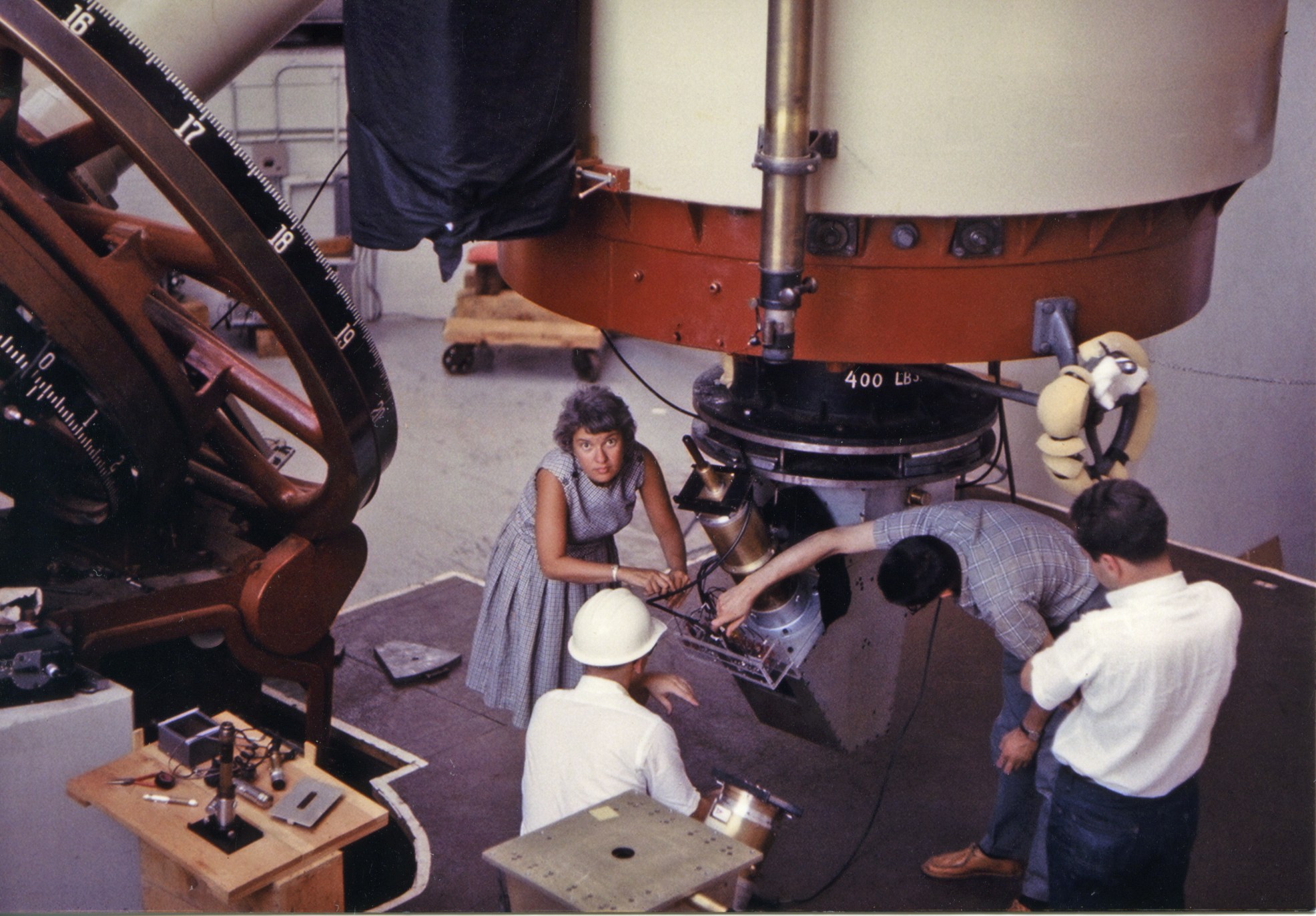
One of the first oral history interviews I delved into was that of renowned astrophysicist Sandra Faber. She is one of the few women scientists that AIP was able to interview repeatedly over the years. Over her career, AIP interviewed her three times—in 19882002 and 2020. I am especially interested in seeing if upon reflection, there were any major changes in how she understood her experiences in grad school and various institutions, as each interview was conducted across various stages in her career.
Read the rest of Dororthy Tang's post at AIP.org and follow along her with her journey into the research archives. 
Faber Works at Telescope Controls.
 

Credit: Astronomical Society of the Pacific, courtesy AIP Emilio Segrè Visual Archives, Physics Today Collection


Thursday, November 13, 2025

Career Profile: Lena Danaia and Inquiry-Based Science Education

The AAS Committee on the Status of Women in Astronomy has compiled dozens of interviews highlighting the diversity of career trajectories available to astronomers, planetary scientists, etc. The interviews share advice and lessons learned from individuals on those paths.

Lena Danaia grew up surrounded by her grandfather’s astronomy magazines. She read through them and chatted with him about the stars and, like many of us, enjoyed gazing up at the night sky.

When Danaia went to college, she focused on becoming a teacher. While in the teacher-training program, she decided to do an honors year. She remembered how much she enjoyed reading about astronomy and her talks with her grandfather, and chose to get involved with the astronomy program. She had the opportunity to do an education-related project with a remote telescope. This reignited her passion for astronomy.

Courtesy of Lena Danaia

Danaia taught school in the United Kingdom and Australia before going through the external process of applying for a PhD scholarship program, where she chose to focus on astronomy education. Her doctoral project centered on student education in astronomy and science. This set the theme for Danaia’s work going forward—she continues to find the links between astronomy and student education.

Danaia is currently an associate professor in the School of Education at Charles Sturt University. She has consulted with many astronomers on the educational aspects of their work. “They need to see if what they’re doing is having an impact.” Danaia assesses how that work is impacting students and teachers and provides education on how to run a program. She has served as the chief investigator on several large-scale research projects. 

One of these projects is “Space to Grow,” a program focused on students in grades 9-12 in Australia. One of the main goals of the three-year project was to develop and implement a professional learning program for science teachers. The program focused on building teacher confidence and competence in using observational data from telescopes in the classroom. In grade 10, Australian students must choose whether they will continue higher-level science courses, and this program was designed to address the falling rate of students interested in these classes, including physics. 

Courtesy of Our Solar Siblings (OSS)

Students used sets of images from telescopes to analyze an open cluster of stars, calculating its distance and age, and learning physics and astronomy concepts like the inverse square law and stellar parallax. While Danaia didn’t write the educational materials, she led the team measuring the impact of the project on students and teachers. Danaia and her team published a review of the Space to Grow project in the 2012 Astronomy Education Review.

Another collaborative educational project Danaia is involved with is “Our Solar Siblings.” OSS is an inquiry-based project for high school-level astronomy that gets students out of the textbook and into real data. The program updates curriculum and materials in accordance with teacher feedback and student responses to the course.


Danaia says of this and other projects, “Most of my work has been collaborative…making sure it’s accessible and will have impact, and asking ‘What’s the benefit for our students and teachers here?’ I always try to report back to our schools so it gets back to them.”

Besides Danaia’s involvement in projects like these, she also teaches research at her university and supervises PhD students. She is also the chief investigator on several other projects, including “Little Scientists,” a program that helps early childhood educators implement inquiry-based STEM projects into their lessons.

Courtesy of Our Solar Siblings (OSS)


When asked about the challenges of working on programs like this, and in astronomy education in general, Danaia said, “Being female working in this space—lots of career interruptions—many of my colleagues haven’t had that. I find some of my colleagues and I put our hands up for many things—playing catch-up in the field—the pressure to volunteer to do so.”

Lena Danaia has published extensively on inquiry-based education in science classrooms, as well as professional development for science teachers, with a focus on using astronomy as a key component. Find out more about Danaia’s research at https://www.researchgate.net/profile/Lena-Danaia